Apresentando o OpenAI Presence
Apresentando o OpenAI Presence, uma plataforma comprovada de agentes de IA para empresas que ajuda organizações a implantar agentes confiáveis de voz e chat para fluxos de trabalho de clientes e internos.
Papers, modelos e datasets em alta no Hugging Face, além do blog oficial — com leitura editorial em português.
Apresentando o OpenAI Presence, uma plataforma comprovada de agentes de IA para empresas que ajuda organizações a implantar agentes confiáveis de voz e chat para fluxos de trabalho de clientes e internos.
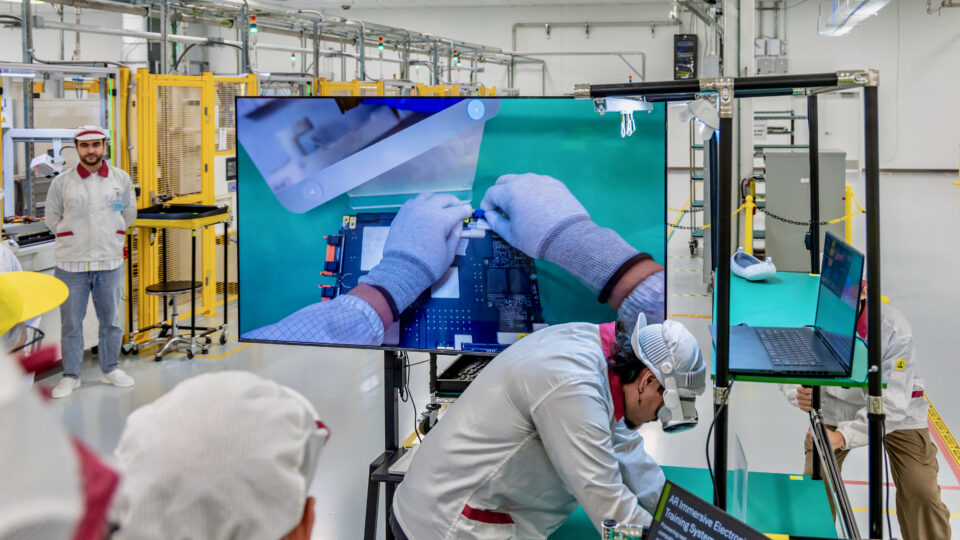
A era da IA funciona sobre infraestrutura de IA. Muitos desses sistemas avançados são construídos e testados no Texas. A Wistron inaugurou hoje sua primeira fábrica de manufatura nos EUA em Fort Worth — uma planta greenfield de 30.100 metros quadrados que produz superchips no coração de alguns dos sistemas de IA mais capazes do mundo. Diante de uma plateia de Wistron […]
Esta reportagem apareceu originalmente no The Algorithm, nossa newsletter semanal sobre IA. Para receber histórias como esta na sua caixa de entrada primeiro, inscreva-se aqui. Ao longo do fim de semana, vários assessores atuais e antigos do presidente Donald Trump em matéria de IA lançaram publicamente insultos contra as principais empresas de IA do país. David Sacks, o "czar" de IA e criptomoedas do presidente até…
O Tongyi Lab, da Alibaba, publicou o Wan-Dancer-14B, um modelo de pesos abertos que gera vídeos de dança coerentes com mais de um minuto de duração a partir de uma foto, uma música e um estilo. O número interessante não é a dança — é o tempo: o triplo do limite prático da geração de vídeo por difusão até agora.
arXiv:2607.15650v1 Announce Type: new Abstract: Recent advances in AI-generated content have driven widespread adoption of Diffusion Transformers (DiTs) for high-resolution, long-duration content generation. While parallelization techniques accelerate diffusion inference, they face significant scalability challenges due to excessive communication overhead in multi-node environments. We observe that sequence partitions in Context Parallelism (CP) exhibit distinct heterogeneity: spatially proximat...
arXiv:2607.15893v1 Announce Type: new Abstract: While the internal mechanisms of autoregressive (AR) transformers have been studied extensively, much less is known about diffusion language models (DLMs), an emerging alternative that generates text by iterative denoising. In this work, we study how DLMs implement induction, a mechanism behind in-context learning in which the model finds a repeated context and copies the token that followed it. Our analysis compares attention-only AR models and ab...
arXiv:2607.15655v1 Announce Type: new Abstract: Masked diffusion language models (DLMs) enable parallel text generation by iteratively refining masked tokens, offering a promising alternative to autoregressive decoding. Recent lookahead-based decoding methods improve the accuracy--efficiency trade-off by exploring future decoding states before committing token updates. However, existing approaches mainly rely on shallow one-step lookahead, which optimizes immediate information gain but can be su...
arXiv:2607.15847v1 Announce Type: new Abstract: Metaphor in Arabic is a culturally grounded mechanism for constructing meaning, encoding cultural knowledge that shapes interpretation. Yet current Arabic language models typically collapse lexical, cultural, and metaphorical information into a single representational space, a phenomenon we term "semantic smearing". We introduce CAMMAR (Culture-Aware Matryoshka for Metaphorical Arabic Representations), a representation learning framework that organ...
arXiv:2607.15286v1 Announce Type: cross Abstract: We investigate whether harmful chain-of-thought (CoT) traces from compromised language models can transfer unsafe behaviour and be distilled into reusable jailbreak attacks. Using an emergent-misalignment organism and a refusal-ablated jailbroken organism, we transplant harmful CoTs into $29$ open-source and $5$ closed-source targets. Transferred traces raise harmful-response rates above $80\%$ on the most vulnerable open-source models, while sem...
arXiv:2607.15482v1 Announce Type: new Abstract: The increasing complexity of state-of-the-art machine learning models has made their behavior progressively harder to interpret, spurring rapid advancements in the field of eXplainable Artificial Intelligence (XAI). Among many methods proposed, perturbation-based approaches play a major role. By systematically altering (perturbing) input features, these approaches measure the impact on the model's predictions. For image data, traditional perturbati...
arXiv:2607.15667v1 Announce Type: new Abstract: Diffusion Transformers have recently achieved strong performance in video generation, yet controlling scene geometry under viewpoint changes and camera motion remains challenging. In this work, we revisit the role of positional encoding in video diffusion transformers and show that it provides a useful spatial bias for geometry-aware control. Specifically, if reference tokens are encoded according to their projected locations in the target view, th...
arXiv:2607.15485v1 Announce Type: new Abstract: Score-based generative models exhibit a puzzling behavior: they often appear to cover all modes of a target multimodal distribution and yet may fail to learn the correct relative mode amplitudes, which can be interpreted as mixture weights. We resolve this apparent paradox by relating the diffusion score matching (DSM) loss to the error in estimating mixture weights from generated samples. We show that, even when the target score is insensitive to ...